
“AI consultant” is a vague job title. Some people who use it sell software. Some write strategy decks. Some build things and disappear. If you run a small business, none of that tells you what you’d actually be paying for, or whether you need one at all.
Here’s the plain version: what the work looks like week to week, what a good consultant should refuse to do, and how we do it at Green Orb.
The short answer
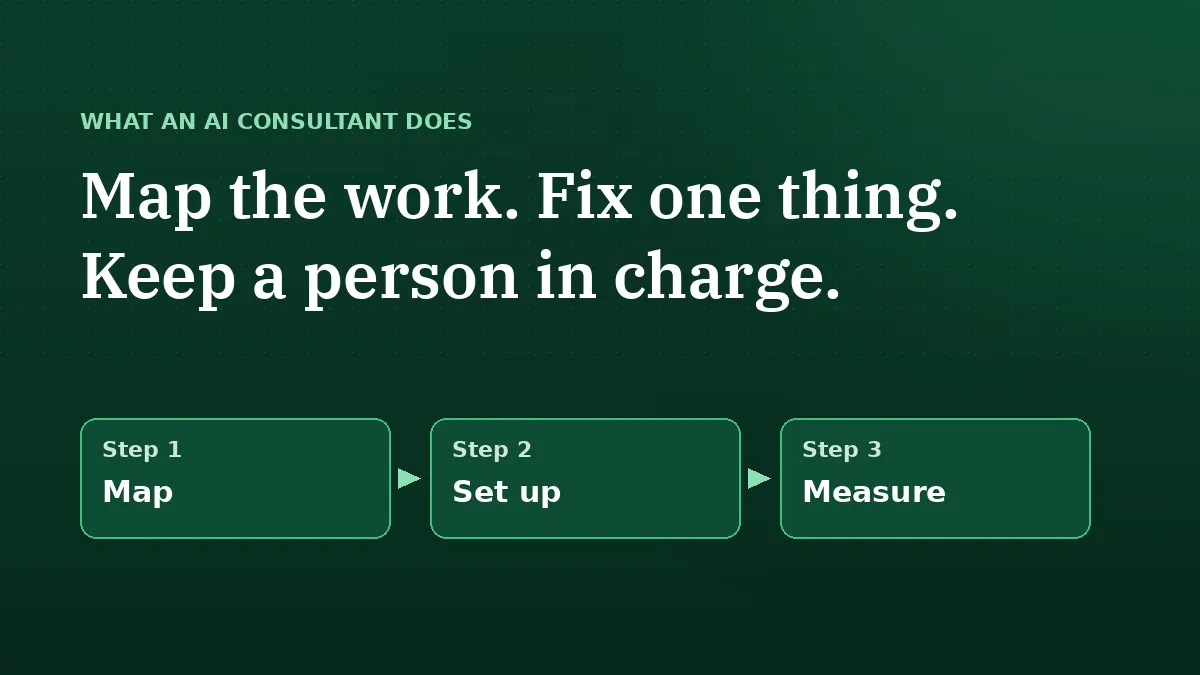
A good AI consultant helps you decide where AI is worth using in your business, sets it up in accounts you own, puts a person in charge of checking what it produces, and measures whether it’s actually helping. Just as important, they tell you where not to use it.
The job is less about the technology than about how your business runs. The tools change every few months. The questions don’t: which work repeats, who checks it, what can go wrong, and how you’d know if it got better.
What the work looks like, step by step
- Map how the work really gets done. Not the org chart, the actual week: the shared inbox, the follow-ups someone writes by hand, the documents staff keep asking about, the details copied from email into a spreadsheet. This usually means talking with the owner and the people doing the work.
- Rank the opportunities. Each task gets weighed on how much time it eats, how often it repeats, and what happens if the tool gets it wrong. Drafting a reply that a person approves is low risk. Sending money or giving legal answers without review is not.
- Say no to the rest. A short list you can act on beats a long list you can’t. A good consultant writes down what to leave alone and why.
- Set up one workflow, with a person in the loop. Start with a single task, built in your accounts, with someone on your team reviewing the output before it reaches a customer.
- Show your team how to use it. A workflow nobody trusts doesn’t get used. Staff need to know what it does, what it doesn’t, and what to do when it’s wrong.
- Measure it against a baseline. Write down how long the task takes before you change anything, so you can tell later whether it improved instead of guessing.
- Keep it working. Vendors change their products, prompts drift, and your business changes. Someone has to watch it, fix it and decide when it’s time to change course.
What a good AI consultant won’t do
- Promise specific savings before they’ve seen how your business works.
- Build everything in their own accounts, so leaving them later costs you.
- Recommend software they’re paid to sell without telling you.
- Remove human review from anything that goes to a customer.
- Ask for sensitive or proprietary data without a clear plan for where it goes and who can see it.
Most small businesses are still early, and that’s fine
If you haven’t done much with AI yet, you have plenty of company. In the U.S. Census Bureau’s Business Trends and Outlook Survey, overall business AI use hovered between 17% and 20% from December 2025 to May 2026. Fewer than 20% of firms with four or fewer employees reported using it, and use among firms with fewer than 20 employees didn’t change significantly over that period.
The SBA’s guide for small businesses gives sensible starting advice: start small and test whether a tool adds value, have another person review what these tools produce, and keep sensitive or proprietary data out of them. (The SBA page now uses the term “super intelligence,” or SI, for what most people still call AI.) It also notes that disclosing how you use these tools is becoming an expected best practice. A good consultant builds those habits into the plan from day one.
For the risk side, NIST publishes a free, voluntary AI Risk Management Framework. A small business doesn’t need to adopt it formally, but your consultant should be able to explain in plain English how they handle mistakes, access and data.
How Green Orb does it
You work directly with Kevin Whitney, backed by a 25-agent operation. Kevin has spent about 30 years in IT leadership and has been independent since 1997. We use AI agents to run our own business every day, so we’ve learned firsthand where they help and where a person has to stay in charge. You can read how we run our own work on about 25 AI agents.
Every price is fixed and agreed in writing before work starts. You own everything we build, and you can stop after any step. All prices are plus applicable taxes.
- AI Audit: $750 flat. Steps 1 to 3 above. Kevin maps how your business runs, ranks your top five time-savers, lists what to leave alone and gives you a written 90-day plan, plus a 30-minute readout. We take on 4 audits a month. If you start a Starter workflow within 30 days, the full $750 is credited toward it. If you don’t, you keep the plan. What the audit includes.
- Starter workflow: fixed price, about $2,500. Step 4 above: one workflow, set up in accounts you own, with a person reviewing its output, live in 2–3 weeks. Common first picks are inbox triage, lead follow-up and a handbook or document assistant. Software subscriptions are billed to you directly by the vendor.
- Monthly care, optional: $300 or $750 a month. Steps 6 and 7: monitoring, fixes when something breaks and monthly hours for changes; Care Plus adds KPIs reported against your baseline. Care is billed monthly and you can cancel any time. How monthly care works.
The full breakdown is on our pricing page, and what an AI consultant costs covers how to compare quotes. The audit gives recommendations and estimates, not a promise of savings, because results depend on your data, processes and people.
Do you need one?
Probably not, if your team is already testing tools carefully and someone has time to own it. It’s worth talking to someone if two or more of these sound like your week:
- Your team writes the same replies, updates and follow-ups by hand every day.
- Staff keep asking where a document is or what a procedure says.
- New inquiries wait for a reply, and some leads go cold before anyone gets back to them.
- Details get copied by hand from email into a spreadsheet or another system.
- You think AI could help, but you don’t know where to start or what it should cost.
Start with a $750 AI Audit
Fixed price, capped at 4 a month, credited toward a Starter if you continue within 30 days. Or book a free 30-minute call first.
Sources
- U.S. Census Bureau, “Large Firms With at Least 20 Employees Biggest AI Users”, May 26, 2026.
- U.S. Small Business Administration, small-business guide to AI (now titled “SI for small businesses”), viewed November 2, 2026.
- National Institute of Standards and Technology, AI Risk Management Framework, viewed November 2, 2026.